.svg)

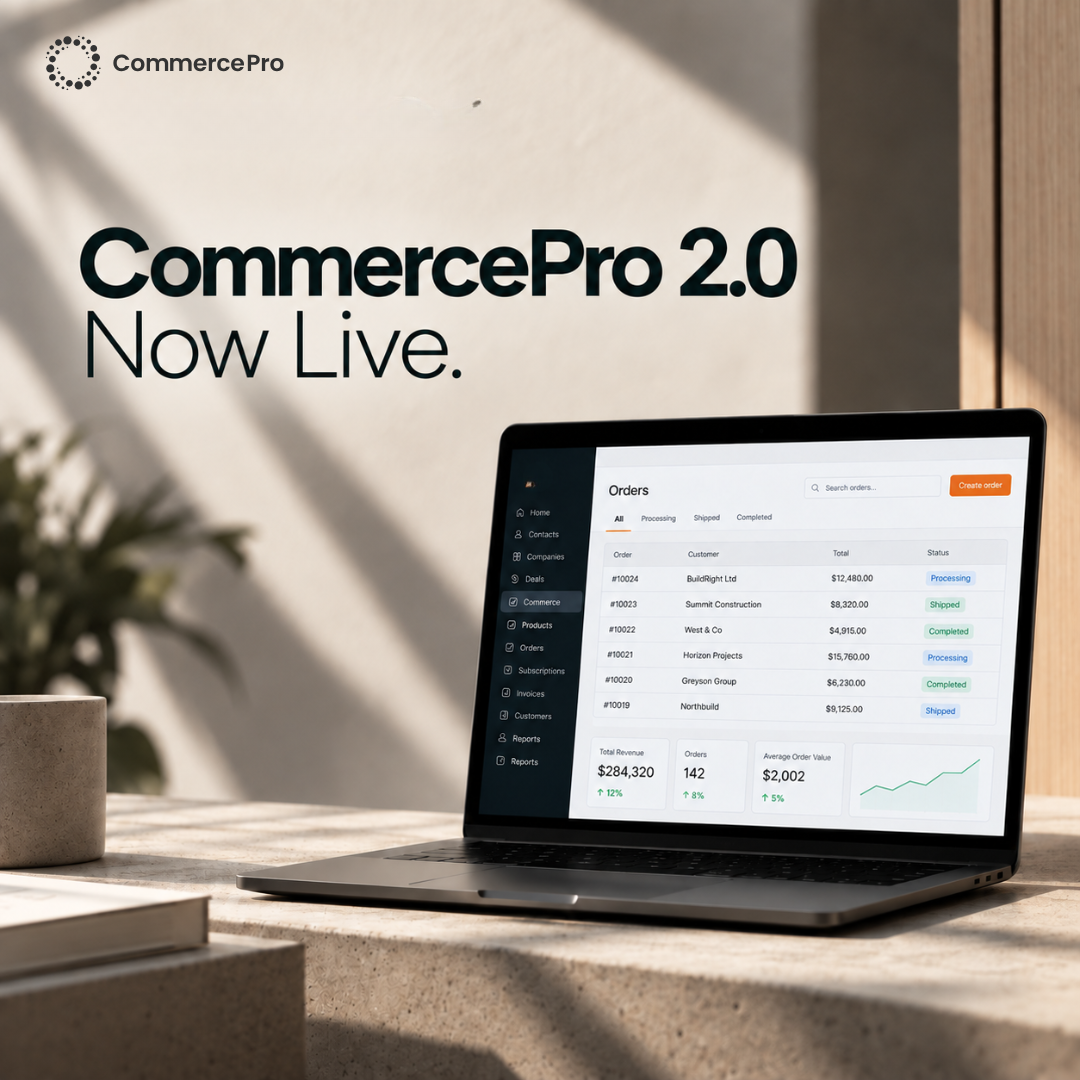
When we first built CommercePro, the idea was simple: if HubSpot is already where you manage your customers, sales, marketing and service, why should commerce have to live somewhere else?
CommercePro brought the storefront, cart, checkout and customer experience into HubSpot.
With CommercePro 2.0, we’ve taken that idea significantly further.
We’ve rebuilt CommercePro around HubSpot’s latest platform architecture, moved our commerce records onto HubSpot App Objects, adopted HubSpot’s native pricing capabilities and brought B2B sales and self-service eCommerce together around the same underlying records.
And there’s one particularly important result:
CommercePro no longer requires HubSpot Enterprise.
CommercePro 2.0 can now run on HubSpot Content Hub Professional, with other Hubs able to remain on Free tiers where appropriate.
For a much wider range of businesses, running commerce natively inside HubSpot just became possible.
Why we rebuilt CommercePro
Until now, some of the records CommercePro needed were built using HubSpot Custom Objects.
That worked well, but Custom Objects required an Enterprise HubSpot licence. It meant the architecture of CommercePro was putting an Enterprise-level requirement on businesses that may not otherwise have needed Enterprise.
HubSpot has since introduced App Objects, which changed what was possible.
Instead of consuming a customer’s own Custom Objects, CommercePro can provision the commerce-specific objects it needs as part of the app itself.
HubSpot has now approved the CommercePro App Objects, and we’ve rebuilt CommercePro around them.
The only paid HubSpot licence CommercePro 2.0 requires is Content Hub Professional.
That requirement exists because we use HubSpot’s own Private Content functionality for secure customer login. Rather than creating a separate authentication system beside HubSpot, customers log in using HubSpot’s native functionality.
We’ve tested the full CommercePro experience end to end on a Content Hub Professional portal with no other paid Hubs enabled.
Storefront. Customer login. Products. Deals. Commerce records. Checkout.
All running inside HubSpot.
1. Your commerce data actually lives in HubSpot
This has always been the philosophy behind CommercePro, but 2.0 takes the architecture further.
CommercePro uses HubSpot’s standard objects wherever HubSpot already has the right object for the job:
- Contacts for people
- Companies for organisations
- Products for what you sell
- Deals for transactions and sales processes
- Line Items for what has been purchased
CommercePro then adds the commerce-specific records HubSpot doesn’t provide through its own App Objects, including:
- Sold Item
- Recurring Revenue
- Membership Tier
- Discount Code
They sit alongside HubSpot’s standard CRM records rather than in a separate commerce database.
That means your teams can use commerce data throughout HubSpot: on contact and company records, in lists, workflows, automation and reporting.
There’s no second commerce platform waiting to sync with the CRM. No middleware trying to keep two versions of a customer aligned. No overnight update before HubSpot knows what somebody bought.
The transaction becomes part of the customer record because it happened there in the first place.
2. Pricing is now HubSpot pricing
CommercePro 2.0 also changes the way pricing works.
Rather than maintaining a parallel pricing engine, CommercePro now uses HubSpot’s own product and pricing functionality, including:
- Unit pricing
- Pricing tiers
- Price books
- Tax categories
- Billing frequency
Tax categories can map directly through to our Stripe integration, keeping the purchasing process connected from product setup through to payment.
Price books are particularly significant.
It’s a capability we’ve wanted for CommercePro for some time, but deliberately avoided rebuilding ourselves because pricing belongs at the product level inside HubSpot.
HubSpot has now released the capability.
So we’re using it.
That’s an important part of how we think about CommercePro. Where HubSpot provides the right native capability, we use it. Where there’s a genuine commerce gap, CommercePro fills it.
3. B2B sales and self-service commerce finally meet
Most commerce platforms are designed around one purchasing path.
But plenty of businesses don’t actually sell that way.
A customer might place a straightforward order online today and speak to a salesperson about a larger or more complex purchase tomorrow.
CommercePro 2.0 supports both.
For B2B and sales-assisted purchases, your team can use HubSpot Deals and Line Items, with HubSpot handling the quoting and CPQ process.
For self-service purchases, customers can buy through the CommercePro storefront and checkout on your website.
But behind the scenes, these aren’t two disconnected sales systems.
They use the same products.
The same customer records.
The same deals.
The same reporting.
And the same customer dashboard.
Sales can sell. Customers can self-serve. HubSpot remains the common thread between them.
4. You no longer need Enterprise
This is the change that opens CommercePro up to an entirely new group of businesses.
Previously, the requirement for Custom Objects meant CommercePro effectively came with an Enterprise HubSpot requirement.
With CommercePro 2.0, that’s gone.
If your business is already running its website on HubSpot Content Hub Professional, you have the HubSpot licence CommercePro needs.
You don’t need to move your Sales, Marketing or Service Hubs to Enterprise just to support your commerce architecture.
And importantly, CommercePro’s App Objects don’t consume your own Custom Object allowance.
The result is a significantly leaner HubSpot setup and a much lower barrier to bringing commerce into the CRM.
Not integrated with HubSpot. Built inside it.
There are plenty of ways to connect an eCommerce platform to a CRM.
CommercePro has never been about building another one.
CommercePro 2.0 pushes that philosophy further than we’ve been able to before.
We didn’t build a commerce system that talks to HubSpot. We built commerce inside HubSpot: its objects, its pricing model, its login and its customer record.
The storefront is the part your customers see.
HubSpot is what sits underneath it.
And with CommercePro 2.0, more businesses can now run that model without needing an Enterprise HubSpot licence.
CommercePro 2.0 launches at UNBOUND 2026.